
Space requirements for static ADAS calibrations vary significantly by vehicle make and model and by the type of sensor being calibrated.
An auto repair shop needs at least a 30-by-50-foot workspace to comfortably accommodate the vehicle, the technicians, and the necessary calibration equipment.
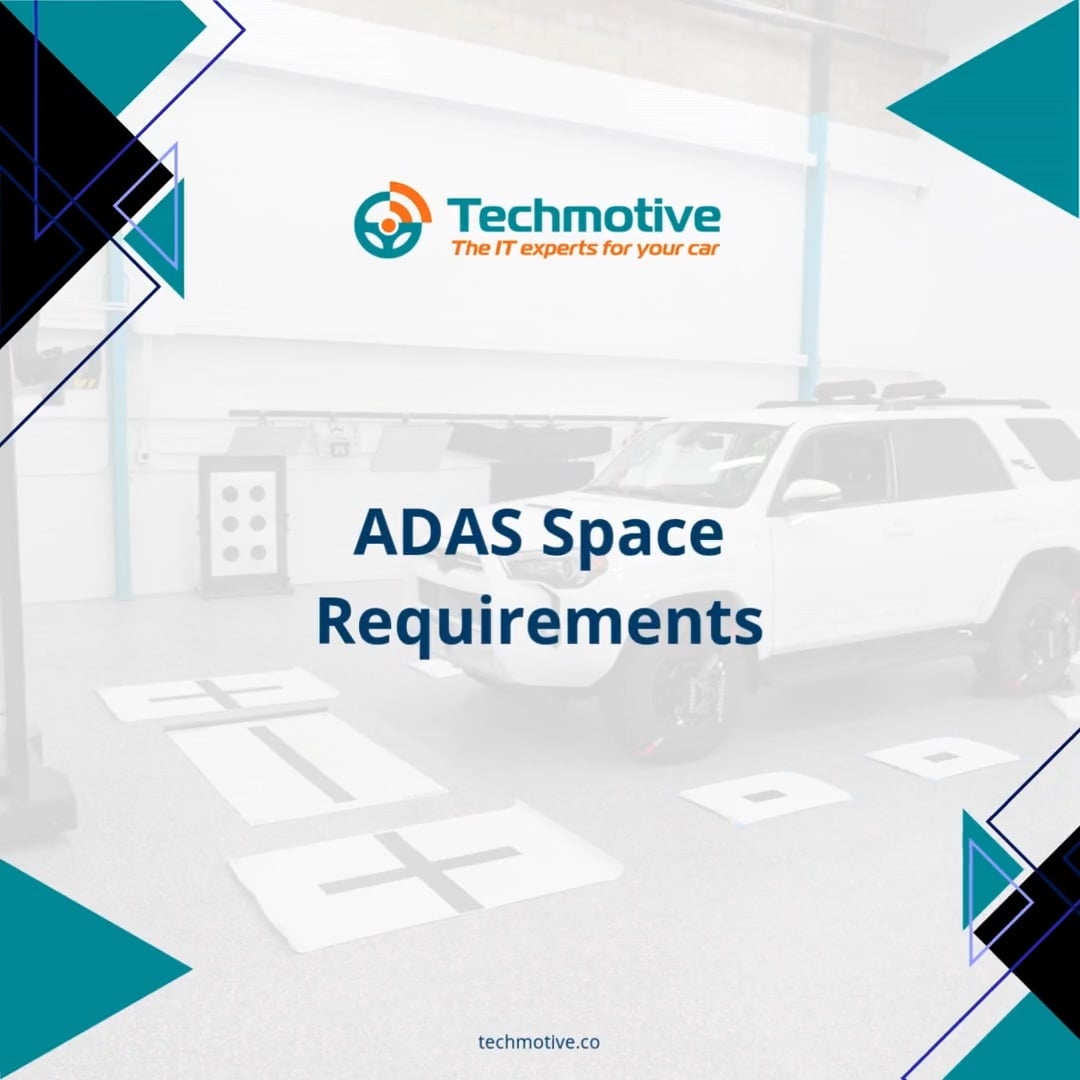
Level floors and non-glare lighting
The environment must be a paved, level indoor area with non-glare lighting, free of background clutter that can interfere with camera sensors and metallic objects that can interfere with radar sensors.
OEM requirements
OEMs have highly specific clearance requirements for their calibrations. Here are some examples.
To properly aim the millimeter-wave radar on a Honda Passport, ensure a clear area measuring 33 feet in front, 13 feet wide, and 4.9 feet high.
Calibrating the blind-spot monitor on a Toyota RAV4 requires an inspection area measuring 19.68 feet wide, 19.68 feet long, and 9.84 feet high.
To inspect and adjust the wide-angle mono camera EyeSight on a Subaru Crosstrek, technicians must park the vehicle and secure 16.41 feet of space directly in front of it to properly set up the target charts.
Because these procedures are unforgiving, checking the exact OEM requirements for each vehicle is critical before promising a customer a timeline. The sheer size and strict environmental constraints of these spaces are major reasons why some standard collision repair shops struggle to perform complex calibrations in-house.
Sources
Repairer Driven News, “Auto body repairer shares perspective on handling ADAS calibration in-house,” 2019. https://www.repairerdrivennews.com/2019/08/27/auto-body-repairer-shares-perspective-on-handling-adas-calibration-in-house/
American Honda Motor Co., “Aiming Driving Support Systems” (Job Aid, Version 12), 2025. https://techinfo.honda.com/rjanisis/pubs/web/docs/AJA03525.PDF
Subaru of America, “EyeSight / Wide Angle Mono Camera Adjustment” (Service Bulletin 07-211-23R), 2024. https://static.nhtsa.gov/odi/tsbs/2024/MC-11008268-0001.pdf