
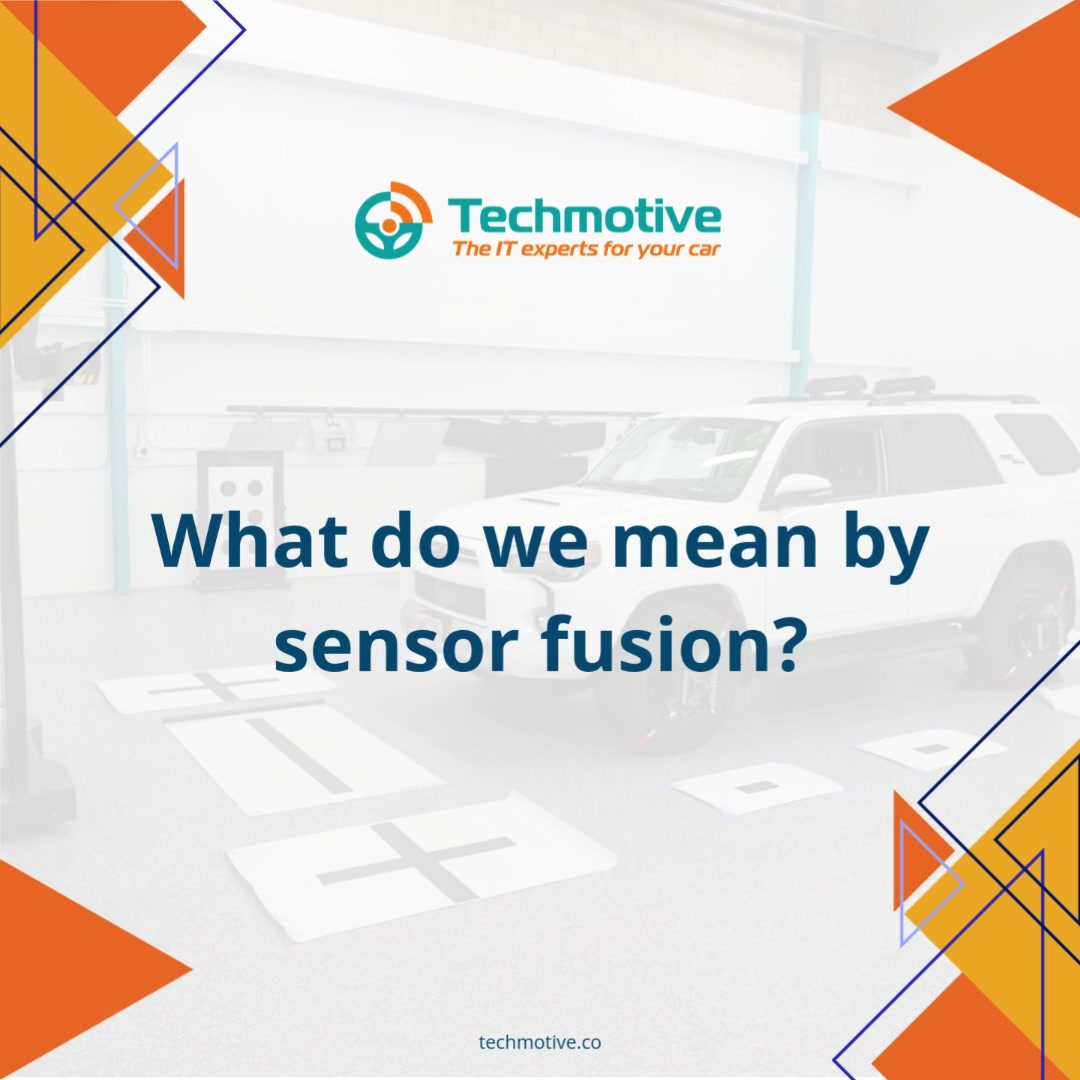
Just as humans use five senses (sight, hearing, smell, taste, touch) to understand their surroundings, modern automotive technology utilizes sensor fusion. Sensor fusion is the process of combining data from multiple sensors to create a more accurate, comprehensive understanding of the vehicle’s environment.
Explanation of Sensor Fusion
ADAS uses sensor fusion by integrating data from radar, cameras, and parking sensors through a processor to provide a more accurate view of the vehicle’s situation, much like humans fuse their senses to perceive and act.
This fusion process enables ADAS to make real-time decisions, such as warning the driver of danger or automatically taking action to avoid a collision.
Importance of ADAS Calibration for Sensor Fusion
If your vision is blurred, your hearing is impaired by noise, or your touch is numbed, your sense of security is compromised. For sensor fusion to work as intended, each sensor’s input must be precise. ADAS systems use sensors much like your eyes, ears, and sense of touch.
Disruption leads to recalibration
If these sensors are disturbed, they must be recalibrated. Even a slight misalignment, such as one degree or a few millimeters, can cause a sensor to aim several feet off target down the road. It’s like being blindfolded in a room and trying to find the doorknob to exit. You could feel around for it, but you might also trip over something.
Reliable object detection
If the sensors feeding data into the fusion system are not accurately calibrated, they cannot reliably detect objects or measure distance, angle, or speed.
Improper calibration can lead to faulty information, causing the ADAS to operate incorrectly, fail to warn or intervene when necessary, or trigger false alarms.
Therefore, proper calibration is essential to maintain the integrity of fused data and ensure safety features such as automatic emergency braking and lane-keeping assist function as designed.
Sources
[1] De Jong Yeong, Gustavo Velasco-Hernandez, John Barry, Joseph Walsh, “Sensor and Sensor Fusion Technology in Autonomous Vehicles: A Review,” Sensors 21(6):2140, 2021. https://pmc.ncbi.nlm.nih.gov/articles/PMC8003231/
[2] Moretti, B., Nakfoor, L., Cole, D., “The importance of ADAS calibration for collision prevention and road safety,” Ascential Technologies (Burke Porter), 2025. https://testandmeasure.ascentialtech.com/wp-content/uploads/2025/07/ADAS-Collision-Prevention-Whitepaper_V3-1.pdf